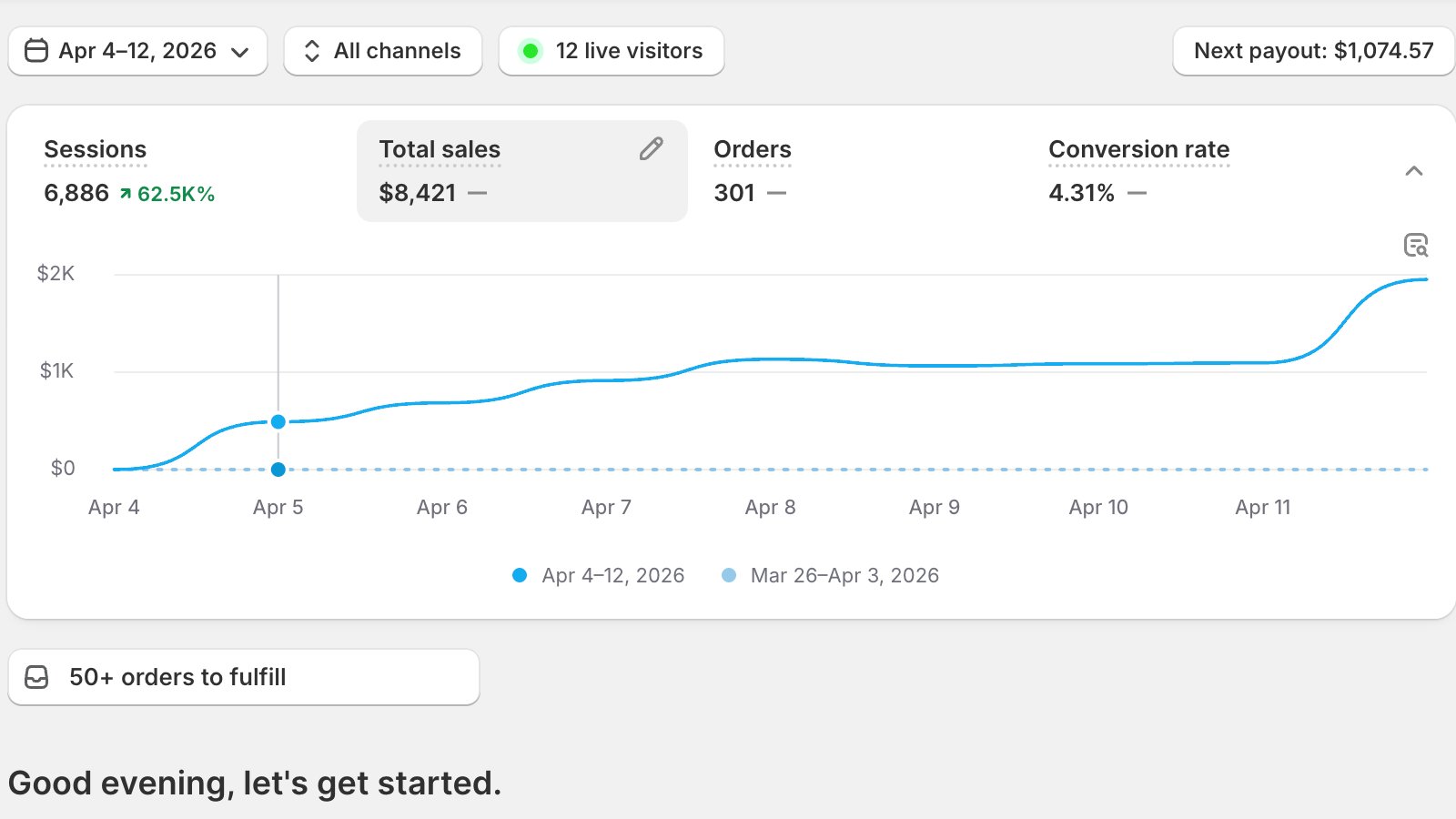
You did it. You have a product that's actually making money. Your 4-ABO test came back profitable — ROAS above 1.3x, CPAs under control. This is the moment every dropshipping guide is leading up to, and also the moment most first-time operators blow it. The goal from here is $100K/month. Everything in this guide is written to get you there before the window closes.
The mistake is almost always the same: they treat the winner like it'll keep working forever. It won't. The window on any dropshipping winner is measured in weeks, not years. The 30 days starting the moment your 4-ABO test hits profitable determine whether this turns into a real business or a one-month spike in your bank account. Here's the playbook.
The window is real and it's closing
Three forces are already working against you the moment your ad starts converting:
- Creative fatigue. The video pulling a 2.5% CTR today will be at 1.2% in three weeks. The algorithm rotates, the audience saturates, and the novelty fades.
- Copycats. A successful ad on Meta typically gets cloned by 3-10 copycat stores within 7-14 days. They bid up the same audience and compress your margins.
- Seasonality or micro-trends. Whatever cultural moment helped your product pop won't last forever. TikTok trends move in 2-week cycles. Seasonal shifts happen quarterly.
This isn't pessimism — it's the default shape of every winner. Plan for it. The operators who build seven-figure businesses from their first winner don't do it by being careful. They do it by executing the 30-day double-down so aggressively that by the time the original ad fatigues, they've already scaled revenue 5-10x and built a cushion.
Days 1–7: pump ad spend aggressively
Most guides at this point say "scale carefully." Forget that. If your ad has been profitable for 7 days with frequency under 2.5, you don't have a scaling problem — you have a speed problem. Every day you sit at $500/day instead of $2,000/day is a day of revenue that's gone forever.
The actual scale rhythm
Assuming your starting daily ad budget is $500 and ROAS is above 2.0:
| Day | Action | End-of-day budget |
|---|---|---|
| 1 | +50% on the winning ad set | $750 |
| 2 | If ROAS holds, +50% again | $1,125 |
| 3 | Duplicate the winner at 2x budget | $3,000 total |
| 4 | Add 2 new broad-targeted ad sets at $500/day each | $4,000 total |
| 5 | Watch — hold all budgets | $4,000 |
| 6 | Kill underperformers, double budget on winners | $5,000–6,000 |
| 7 | Add 1% lookalike of purchasers | $6,000–7,000 |
You ended the week spending roughly 12–14x what you started. If ROAS stayed above 1.7 blended, you're also earning 12–14x. If it dropped to 1.2, you pull back. But the thing is: you tried. Most operators never do.
Here's what almost always happens: Day 3 or 4 has a bad morning. Revenue is down 30% from yesterday. Panic sets in. The operator kills ad sets or slashes budgets. Don't. Meta's delivery isn't hour-to-hour consistent. Give any decision a full 3-day window before acting. The operators who win are the ones who hold through the dips.
Days 8–14: flood the creative pipeline
By day 10, your original winning creative will show signs of fatigue. Frequency will climb past 2.5. CTR will dip. ROAS will compress. This is expected. The fix isn't finding a magical new winner — it's having 10 new creatives ready to go before the current one dies.
The week-2 creative production sprint
Block one full day for production. Produce:
- 3 UGC clips from hired creators (Billo / Insense / Upwork) — ordered day 7, delivered day 10–12
- 3 founder-filmed clips on your phone — you testing, showing, using the product casually
- 2 testimonial-style clips built from real customer reviews with CapCut + AI voiceover
- 2 demo clips showing the product in use with text overlay
Launch them in batches of 3–4 per ad set, replacing older creative as it fatigues. The goal isn't to find "the new winner" — the goal is to have enough new fuel that the overall campaign never stalls. Top operators maintain this tempo for months.
Days 15–21: AOV and subscription
By this point you're doing real revenue daily. The question shifts from "can I acquire customers?" to "how much is each one worth?" Three changes to make this week:
Add a subscription option
If your product has any consumable or renewable element, the subscription goes live this week. Not next month. Not when you have time. This week. A 30% subscription attach rate doubles your effective LTV overnight. Covered in depth in the subscription playbook.
Build a bundle
2-pack and 3-pack with compounding discounts. Display all three options on the product page with the middle option highlighted. Expect 30–50% of customers to pick the bundle. AOV jumps 40–70%, and since your ad cost per order is unchanged, your contribution margin improves dramatically.
Install post-purchase upsell
Vitals, UpSellKit, or similar — $29/month. One-click post-purchase offer for a complementary product at a discount. 8–15% take rate is normal. Pure margin on each one.
Combined impact of week 3: your effective CPA drops by 20–35% without spending a dollar differently on ads. That's the math change that makes the final week possible.
Days 22–30: diversify before the fall
You're running hot on Meta. You've added subscription and AOV plays. The final week's mission: get at least one backup channel spun up before Meta's inevitable next hiccup.
In priority order
- Days 22–24: Google PMax. Upload your Meta creative as ad assets. Target a $30–50/day budget to start. Don't expect instant returns — Google's learning phase takes longer. But by day 45, it'll be doing 15–25% of your revenue.
- Days 25–27: TikTok Shop affiliate. Seed 15–20 creators with your product using the script patterns from the creator seeding playbook. Some will post. Some of those will pop.
- Days 28–30: Email infrastructure. If you haven't already, install the full Klaviyo flow suite — abandoned cart, post-purchase, winback, review. Should be contributing 20%+ of revenue by day 60.
End-of-30 state
What kills this plan (and it's not the market)
The plan above works. It's been executed by dozens of operators. The thing that kills it, nearly always, isn't external. It's the operator's own hesitation.
- Slow-scaling out of fear. "What if tomorrow is worse?" Tomorrow is always uncertain. Scale anyway. The worst case is you pull back.
- Overthinking the next move. "Should I add Google or TikTok Shop first?" It doesn't matter. Pick one. Make the wrong decision fast.
- Waiting for systems before scaling. You can hire next month. The window is now. Systems solve problems scale creates; they don't create scale themselves.
- Getting comfortable. Hitting $30K/month feels amazing. You relax. You stop shooting creative. Three weeks later the ads have fatigued and revenue is back at $15K. The discipline has to hold past the dopamine.
The operator who wins isn't the smartest, the most capitalized, or the most connected. They're the one who moved fastest when the window was open.
Your first winner is the most valuable 30 days of your dropshipping career. The business you build during this month determines whether you're running a seven-figure store next year or hunting for another winning product in two. Execute fast. The window is real, and it will close.