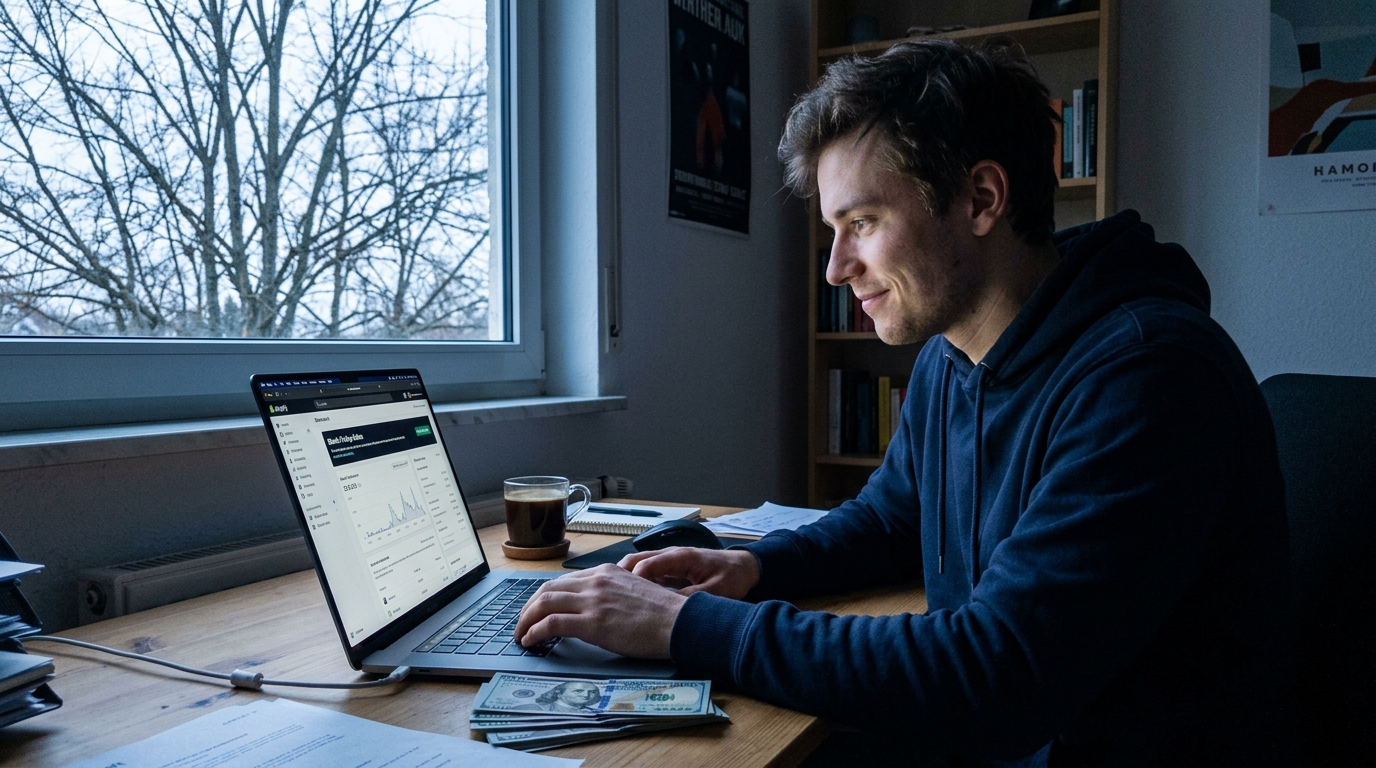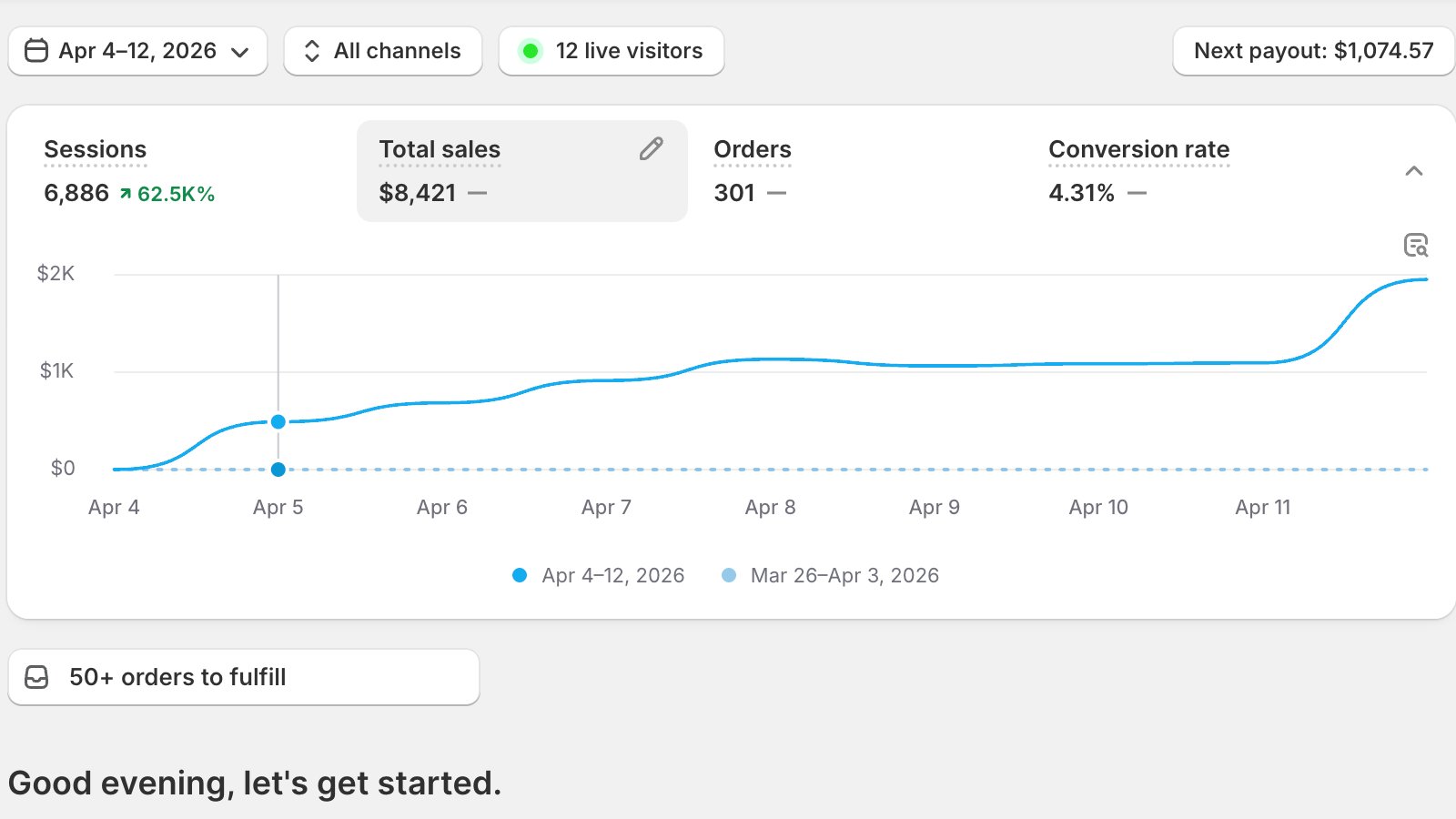
The standard advice is cautious. Raise ad budget 20% every three days. Hire before you scale. Build systems before volume. That advice isn't wrong — it's just written for a specific scenario, which is an operator who doesn't yet have product-market fit.
If you have PMF — meaning your ad has been profitable for at least 7 days, your creative isn't fatigued, and your product converts — the cautious advice is actively costing you money. Every day you sit at $300/day when you could be at $3,000/day is a day the top 5% of operators are pulling further ahead. Speed, not patience, is the lever here.
When scaling fast actually works
Be honest about whether you're in the right phase. The speed playbook only works if you meet these four triggers:
- Your 4-ABO test cleared profitable at the 5x-product-price threshold (not one lucky day).
- Your frequency is under 2.5 — meaning the audience isn't tapped out yet.
- Your supplier can handle 3–5x current volume without breaking.
- Your refund rate is under 5% — confirming the product actually delivers.
If you have all four, you don't have a scaling problem. You have a speed problem. The market is giving you a window, and the window is weeks, not months. Every dropshipping winner fatigues eventually. Your job is to harvest it.
A profitable ad creative in 2026 typically has a 14–30 day peak window before fatigue compounds and CPA rises. If you slow-scale over 6 months, you only capture the bottom of the curve. The operators doing $100K months caught the top.
Week 1: pump the winner
The first move isn't strategy. It's volume. You have an ad that's working; your job this week is to give it fuel.
Scale rhythm for a proven winner
| Day | Budget action | What to watch |
|---|---|---|
| Day 1 | Jump current winning ad set 50% | ROAS + frequency over 24h |
| Day 2 | If ROAS holds, jump another 50% | CPA + ATC rate |
| Day 3 | Duplicate the winning ad set at 2x budget | Whether Meta finds new pockets |
| Day 4–5 | Add 2 new broad audiences at same budget | Which new ad set scales |
| Day 6–7 | Add lookalikes of purchasers (1% and 3%) | CPA comparison across sets |
The 20%/3-day rule is for ads still learning. A proven winner with $30 CPA and 3.2 ROAS handles 50–100% daily jumps without collapsing — the trick is to know the difference. If ROAS drops more than 20% after a budget jump, pull back to the prior level. But most operators never even try the aggressive jump and leave weeks of growth on the table.
End of week 1 target
If you started Monday at $500/day in ad spend, you should end Sunday at $1,500–$2,500/day. Revenue follows the next week as the delivery cycle completes. Week 1 is about putting the fuel in the tank. The numbers show up in weeks 2 and 3.
Week 2: flood the creative pipeline
The biggest failure mode of fast scaling: creative fatigue hits before you've scaled. Your winning ad was fresh when you started scaling; by day 10, it's been seen too many times.
The fix is preemptive: in week 2, launch 10 new creatives minimum. Same product, same offer, same page — different hook, different angle, different creator. Don't wait for the current winner to die.
Creative production at scale
- 3 creator-led UGC clips (Billo, Insense, or your seeded creators)
- 3 founder/brand clips you film on your phone in under 30 minutes
- 2 testimonial-style clips built from real customer reviews with AI voiceover
- 2 demo/explainer clips showing the product in use with text overlay
Total production time: about one full day if you batch it properly. Expect 2–3 of the 10 to beat your current winner. That's the pipeline. Do this every week for the rest of the scaling phase.
If your best ad is your only ad, your best day is next week.
Week 3: subscriptions, bundles, AOV
At this point, you're doing real revenue. The question shifts from "can I acquire?" to "how much is each customer worth?" Three levers to pull, in priority order:
Lever 1: Subscription option
If your product supports it — and most do, with some creativity — add a subscription tier. Refills, consumables, companion products. The vacuum brand that sells $70 vacuums and $15/month replacement filters doesn't live or die by Meta's algorithm. A store with 30% subscription attach has a ~$180 LTV on a first order, not a $45 one.
Lever 2: Bundles
Build a 2-pack and 3-pack version of your hero product at a compounding discount. Display all three options on the product page with the middle one highlighted. Typical result: 35–55% of customers pick the bundle, average order value jumps 40–70%, and your effective CPA drops because more revenue comes from the same acquisition cost.
Lever 3: Post-purchase upsell
A one-click upsell on the thank-you page offering a complementary product at a discount. 8–15% of customers take it. Pure margin, zero ad cost.
All three are one-afternoon installs. In aggregate, they take a $30 CPA store from $45 AOV to $75–95 AOV. Same ad spend, 60%+ more revenue. That alone can take you from $30K to $50K/month without adding an ad dollar.
Week 4: second channel
You're now concentrated on one channel (probably Meta). That concentration is how you got here — but it's also your single point of failure. Week 4's job: diversify before week 5's ad account issue makes it necessary.
- If you're Meta-only: launch Google PMax with your winning creative assets. Typical result: 15–25% of revenue within 4 weeks, largely incremental.
- If you're Meta + Google: add TikTok Shop with the affiliate model. Send samples to 20 creators with the exact hook that's working on Meta.
- If you have all three: push email + SMS flow revenue from 15% to 30% of total. It's the cheapest channel and it's almost certainly underbuilt.
End of week 4 target
Not every store follows this exact curve — but stores with the trigger conditions met regularly do it in 30 days or less. Some faster. A friend in the space went from $8K/month to $140K/month in 19 days last September when her hero creative took off. She didn't hire a team, she didn't build systems. She pumped ad spend, made new creatives daily, and installed subscriptions. The scaling was the only thing she did.
The three emotional traps that kill scaling
More stores fail at this point from emotional decisions than from actual business problems.
Trap 1: Killing ads on a single bad day
You scaled to $2,000/day. Tuesday does $800 in revenue. Panic sets in. You slash the budget. Meta's learning phase breaks. By Thursday your best ad set is dead. The fix: 3-day minimum evaluation window before any kill decision. Meta's delivery isn't hourly-consistent, and scaled campaigns fluctuate even more day-to-day. One bad day means nothing.
Trap 2: Pausing to "let it stabilize"
Every instinct says to pause scaling to let things normalize. Don't. Your creative window is closing the whole time. Stability at $1K/day for a month equals $30K — hitting $5K/day for 10 days equals $50K. You're not building a stable business at this phase; you're harvesting a time-limited opportunity.
Trap 3: Overthinking the next move
At $5K/day in revenue, most first-time operators freeze. Too many possible moves. Should they hire? Expand internationally? Launch a second product? Analysis paralysis kicks in and they make no decision. Make the wrong decision fast; the wrong decision can be corrected, the un-made decision can't.
What changes at $100K
Crossing $100K/month is less of a milestone than it's sold as. The business is still the same product, same audience, same ad strategy. What changes is that the quality-of-life improvements get real:
- You finally have enough margin to hire a VA without thinking about it.
- You finally have cash flow to stock inventory instead of dropshipping unit-by-unit.
- You finally have the buffer to survive an ad account issue.
But the habits that got you here — fast creative pipeline, aggressive scaling on winners, subscription-first product design — still govern everything. Operators who get to $100K and then suddenly slow down trying to "build a real business" often watch it slide back to $50K. The speed is the business.
Scaling isn't a different skill from building a winner. It's the same skill, applied with more budget and more nerve.
The 12-month scaling advice is safe because 12 months gives you time to recover from mistakes. But it also gives your creative time to die, your niche time to saturate, and copycats time to clone your offer. The operators who do this in weeks instead of months aren't smarter. They're faster. And in dropshipping in 2026, fast is the only compounding advantage.