Pull up any dropshipper's X feed and you'll see screenshots of $100K revenue months. What you don't see is the terror underneath them: most of those stores are running on a single winning product and a single winning ad. When the ad fatigues — and every ad fatigues — the revenue disappears in a weekend. That's not a business. That's a lucky hand.
The operators with actual businesses have something the screenshots don't show: MRR. Monthly recurring revenue from subscriptions. It's the single biggest differentiator between a store that survives and one that doesn't — and it's almost always the thing the operator added before they scaled, not after.
Why winners without subs die
Here's the lifecycle of a typical dropshipping winner:
- Month 1–2: Creative pops. Store rides a $50K–$150K/month revenue wave.
- Month 3: Ad fatigue starts. CPA rises. Copycats appear on Amazon and other stores.
- Month 4–5: The numbers slide. Operator scrambles for new creatives, new angles.
- Month 6: The wave has collapsed. Operator is back to testing new products — and has no cushion.
This is the default lifecycle because the business is built on acquisition only. Every dollar has to come from a new customer. When the ad stops acquiring, the business stops earning.
A store with a subscription attached works differently. Even if the ad stops working on Day 90, every customer who subscribed before then continues to pay every month. Month 4 still does real numbers because last month's buyers are this month's revenue. The wave collapse becomes a wave transition — revenue shifts from new to returning — instead of a cliff.
Here's a good test for whether you have a subscription business. If you stopped all ad spend and all posting tomorrow — completely went dark for 30 days — would your store still do real revenue in that month? With subscriptions, yes. Without, no. That's the difference.
The $70K MRR math
Consider two stores, both at $100K/month total revenue:
| Line | One-off store | Sub-heavy store |
|---|---|---|
| Monthly revenue | $100,000 | $100,000 |
| New customer revenue | $100,000 | $30,000 |
| Subscription revenue (MRR) | $0 | $70,000 |
| Monthly ad spend | $35,000 | $12,000 |
| Contribution margin | ~$22,000 | ~$48,000 |
| Revenue if ad account disabled | ~$0 next month | ~$65,000 |
| Business value at 3x profit multiple | ~$660K | ~$1.7M |
Same top-line. Very different business. The subscription store is nearly 2.5x more valuable at equal revenue because the earnings are predictable and ad-independent. Buyers pay a premium for that stability. Founders benefit from it every single month.
Turning any product into a subscription
Most dropshippers assume their product "isn't a subscription product." In almost every case, this is wrong. The product isn't the subscription — the extension of the product is. Here's the template.
Step 1: identify the consumable or renewable
Every product has something that gets used up, worn out, or refreshed. That's the subscription. For the vacuum that filters dog hair, the filter is the subscription. For the water bottle, it's replacement lids or cleaning tablets. For the skincare device, it's the serum that goes with it. The physical product is the entry point; the consumable is the recurring relationship.
Step 2: price the subscription so the main product is the loss leader
The math that makes this magic: the core product at a near-breakeven price, the subscription at strong margin. You're not trying to profit from the first purchase — you're trying to acquire the subscriber. Once they're on the recurring, the lifetime value is 5–15x the first-month revenue.
Step 3: make the subscription the default, not the upsell
On the product page, don't present subscription as an afterthought. Make it the featured purchase option. The pattern that converts:
- Option 1 (highlighted): One-time $X
- Option 2 (featured, badged "Most Popular"): Subscribe & save 20% — $X.YZ/month
With this framing, 30–55% of buyers choose subscription over one-off. Without it — when sub is just a toggle or a post-purchase offer — maybe 8% take it. Same product, different default, completely different business.
Three subscription models that work
Model 1: The refill/consumable
Works for anything that gets used up. Supplements, filters, cleaning solutions, shaving blades, dog treats, skincare serums, coffee pods. You sell the device or first unit, then the consumable recurs. Simplest model to set up, highest subscriber retention because the need is recurring by nature.
Model 2: The auto-replenish
Works for products with predictable usage cycles. Contact lenses, pet food, toothpaste subscriptions. The customer doesn't think about it — the product arrives when they'd be about to run out. Lower emotional buy-in from customer but very sticky once enrolled.
Model 3: The curated box
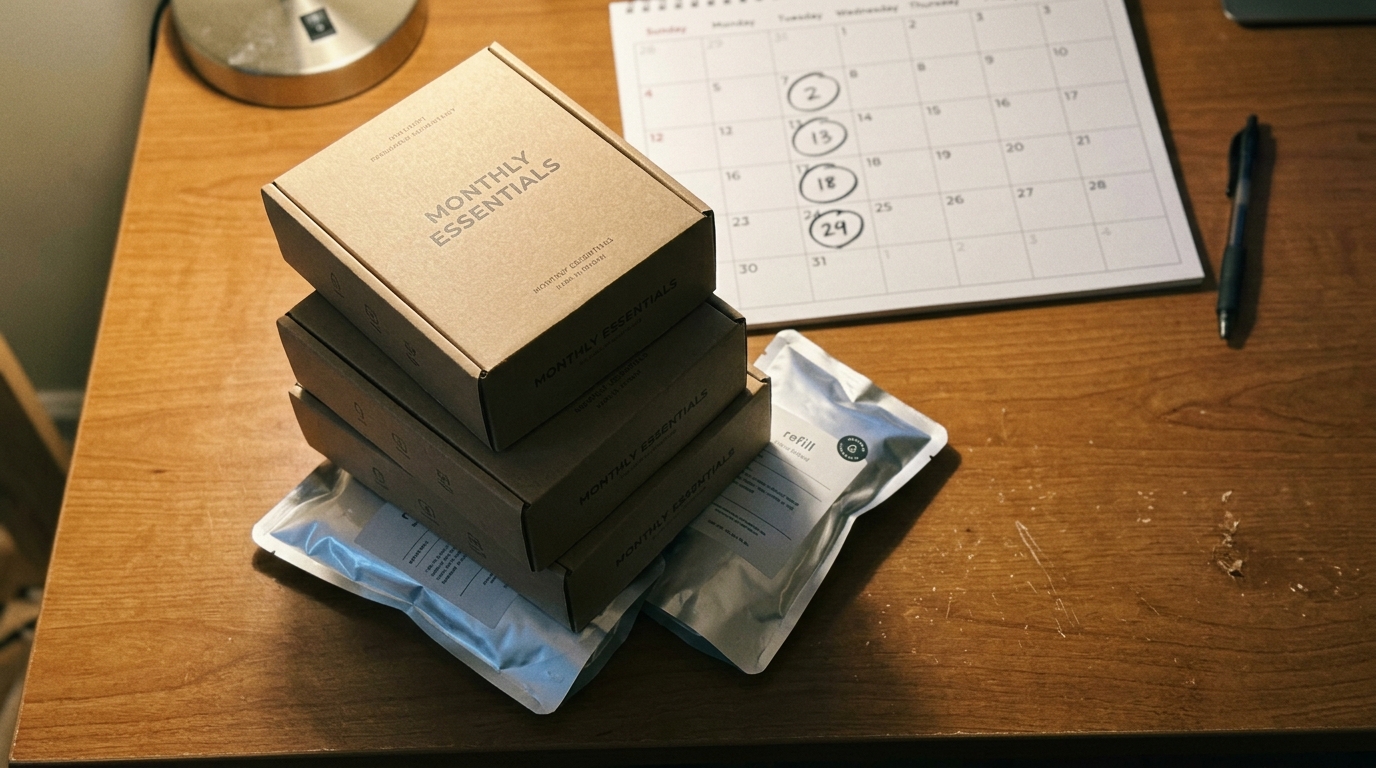
Works when you have multiple complementary products in the same niche. A seasonal dog treats box. A monthly skincare sampler. Higher effort to run (you curate new items monthly), but creates anticipation and emotional engagement that the other models don't. Churn is typically higher but so is LTV.
Churn: the one number that makes or breaks you
Every subscription business is really just a tug-of-war between new subscribers coming in and old ones canceling. If the cancellation rate (churn) is low, your base grows every month. If it's high, you're running on a treadmill.
Healthy monthly churn benchmarks
- Under 5%/month: Excellent. Your base grows faster than it leaks.
- 5–10%/month: Normal for most dropshipping subs. Manageable.
- 10–20%/month: High. Something structural is wrong — pricing, product, or expectations.
- Over 20%/month: Broken. You're running to stand still.
Churn reduction tactics that compound
- Pause instead of cancel. Most churn is triggered by "I have too much." Offer a 30-day pause button. 40–60% of would-cancel customers pause instead and re-activate later.
- Skip-a-month option. Same logic as pause, lighter touch.
- Cancellation exit offer. When they try to cancel, offer one month free or 50% off. Recovers 15–25% at negligible cost.
- Replace failing payments fast. 2–5% of churn is just expired credit cards. Klaviyo + Shopify + a "card expiring soon" flow captures most of it.
What to do if your product truly can't be a sub
Some products really don't fit — a one-time device with no consumable, a piece of furniture, something with a 3-year lifespan. Fine. In that case, the move is to run two products: the one-off primary product that feeds the top of the funnel, and a separate companion subscription product that the buyer converts into after the first purchase.
Example: store sells a weighted dog vest (one-off). Post-purchase email offers a monthly subscription for calming treats in the same niche. The buyer is already proven to have an anxious dog and trust the brand. Conversion rate on this cross-sell runs 20–40%. The two-product model retrofits subscription onto a non-sub category.
Every operator doing seven figures in dropshipping either has a subscription product or figured out how to retrofit one. The ones who didn't are running on last month's ad creative.
The subscription isn't a tactic you add at $500K/year when you "have time." It's the lever you add at $10K/month that makes $500K/year possible. Install it early. Default it on the product page. Price the consumable to compound. The difference between a six-figure and a seven-figure dropshipping business is usually this one thing.